
Management of radioactively contaminated metallic waste for disposal and studies for the planning of the decommissioning of the two reactor sections of the former Paldiski nuclear site and the construction of a radioactive waste disposal site, including impact assessment 2019 - 2023.
The short name of the project is RAJALA (radiioactive jäof laThe total cost of the project is EUR 8.355 million, of which the contribution from the EU Cohesion Fund is EUR 85% and the contribution from the Environmental Programme of the SA Environmental Investment Centre is EUR 15%. The project will be implemented in the period 2019 - 2023.
The aim of the project is to reduce the risks associated with radioactive waste and its management in order to prevent pollution of groundwater and surface water, which poses a threat to human health.
The project consists of five activities:
- Investigating the impact of the establishment of a radioactive waste disposal site from different environmental and socio-economic perspectives. The activity will provide an accurate overview of the parameters, etc., of the possible locations of the disposal site, as an input to the planning and impact assessment.
- Engineering and radiological studies for the decommissioning of the reactor sections at the former Paldiski nuclear site. The activities will provide the necessary technical baseline data for the safe execution of the decommissioning works, the proper management of the waste generated, etc., as input for the impact assessment.
- Preparation for the management of radioactively contaminated metal waste for disposal at the former Paldiski nuclear site. Most of the metallic waste was contained in underground piping that connected the various facilities at the Paldiski site to the reactor sections in the main building, and through which radioactive liquid waste or radioactively contaminated air passed. Between 2024 and 2026, the metal waste is planned to be transported to a smelting plant outside Estonia, where it will be cleaned and smelted to reduce the volume of waste. Concentrated returnable radioactive waste will be transported to a treatment centre at the Paldiski site for further treatment, concreting and packaging for disposal. The waste will then be stored in an interim storage site until its final disposal in a final disposal facility to be constructed. This activity will provide for the acquisition of a concrete node for the management of the concentrated radioactive waste to be returned and concrete containers for the storage of the waste.
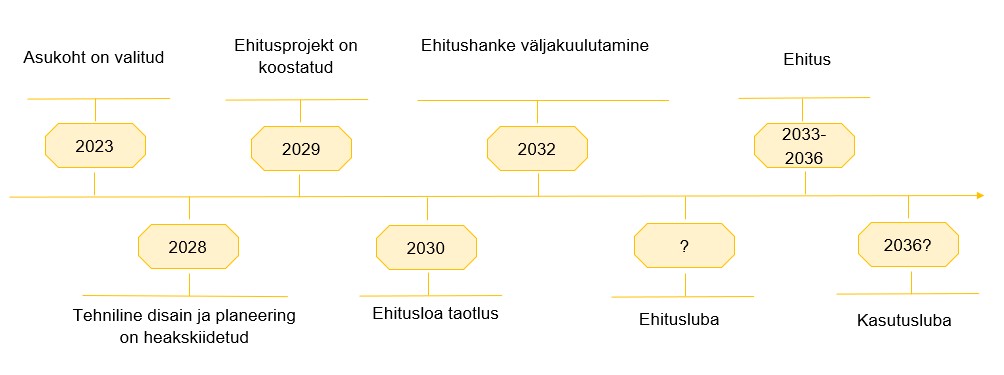
- Planning and impact assessment activities for the siting of the final disposal site. The activities are partly cross-border, as Estonia is obliged to assess the cross-border impacts of the construction of a disposal site as part of the Strategic Environmental Assessment.
- Communicating the activities and results supported by the project to the public.
As a result of the project, preconditions have been created for identifying the most suitable site for final disposal and for decommissioning the reactor sections. Planning and impact assessments have been initiated, and the public has been proactively and clearly informed about the project objectives, activities and their results. Radioactively contaminated metal waste from the former Paldiski nuclear site has also been managed for disposal and 1.18 hectares of land have been rehabilitated. As a result, the safety of the surrounding environment and human health has been better protected. The objectives of the National Action Plan on Radioactive Waste have been met in terms of the long-term safe management of radioactive waste and the reduction of radioactive waste generation.
The project is implemented by AS ALARA, whose contact person is Ivo Tatrik, phone 51 51 111, e-mail ivo.tatrik@alara.ee and Alari Kruusvall, phone 523 7126, e-mail alari.kruusvall@alara.ee
The project partner is the Ministry of Climate, whose contact person is Maria Leier, phone 5306 5651, e-mail maria.leier@kliimaministeerium.ee