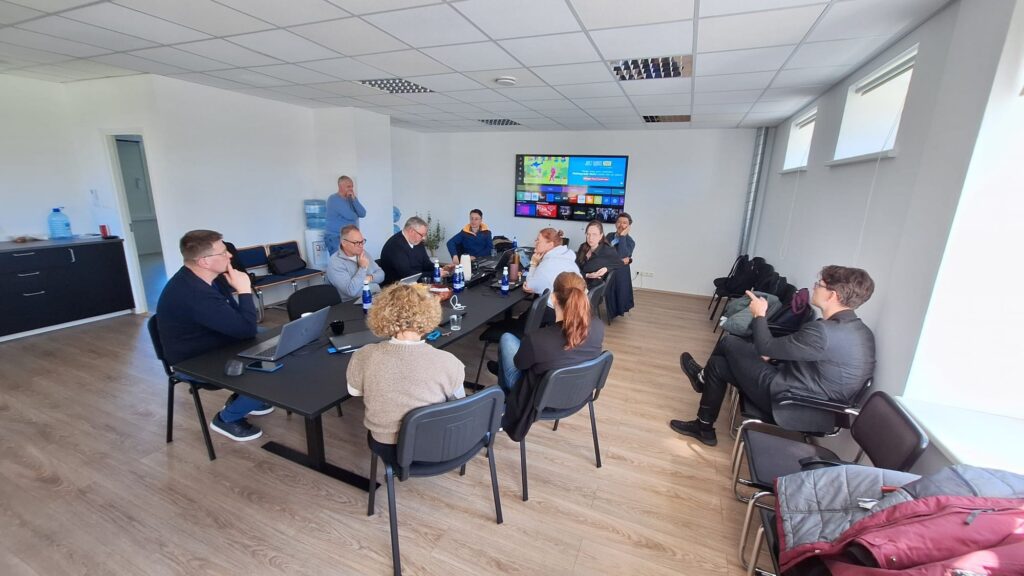
Last week, an IAEA expert mission visited Estonia, focusing on the decommissioning of the reactor sections of former nuclear submarines located in Paldiski.
Together with AS ALARA, the Environmental Board and the Ministry of Climate, the studies conducted by AS ALARA to date were reviewed at a joint table, the Paldiski nuclear site was visited and the next activities necessary for decommissioning were discussed, both in the short term and in the long term. The independent view of IAEA experts Vladan Ljubenov, Egidijus Babilas, Szabolcs Czifrus and Tom Hansen and examples from their decommissioning practice helped bring new opportunities and ideas to the table, which activities to move forward with as a priority in the future and which activities to plan in the long term and in what order.
The decommissioning of the Paldiski reactors is made special by the fact that information on Soviet-era military reactors is limited and, in today's international political situation, it is not possible to obtain additional information. The available information on the radiation situation of the reactors is sometimes contradictory and its reliability has not been proven. In addition, the reactor compartments are partially filled with concrete, which makes it impossible to assess their radiation situation in more detail without entering them. However, in order to draw up a detailed decommissioning plan, it is necessary to obtain more accurate and fact-based information on the radioactive isotopes and their activities in the reactor compartments.
Since no one has entered the reactor sections since they were closed by the Russian military in 1994, the next step is to obtain a visual overview of their interior and map the radiation situation there.
After this activity is completed, it will be possible to begin preparing a detailed decommissioning plan. Step by step, with cooperation and support from the international community and state funding, it is certainly possible to begin the decommissioning of the Paldiski reactors as planned, i.e. in 2040.